Acrostic Poems, After School Class:
Judy is not
Ugly even though she looks a
Duck,
Yeah.
– Judy, 1st Grade Student, Seokjeon Middle School
Do you like
Apple?
No, I like melon.
– Dan, 1st Grade Student, Seokjeon Middle School
On top of all my adventures in South Korea, I was lucky enough to travel around Asia a bit while I was in the neighborhood. Before my big trip in the winter, I had heard that a lot of people living in Korea felt that they missed it as they traveled around. For me, it came as a refreshing break as well as an eye-opener as to how different all of Asia is. Had I not traveled, I might have made the grave mistake that all of Asia, or at least East Asia, is like Korea. It isn’t. As far as I could tell, all of the countries I visited – Taiwan, Thailand, Cambodia, and Japan along with Korea – had about two things in common. They were full of Asians. And they all led to ridiculous escapades.
My first step out of Korea was in Taipei, where a couple of my college friends waited outside my gate at the airport waving my name on a sign. Although I was more or less all on my own in Korea, venturing into a ‘foreign’ country alone seemed much more overwhelming and I can’t say how glad I was to have my Chinese-speaking friends as a guide. As we made our way to their small city, I was hit with a wave of tropical island air. Palm trees lined the street. Everything was flatter and more spread out, and there were parks everywhere with young boys and older women were playing basketball. Taiwanese food was delicious, but a very different delicious from hot peppery, garlicky Korean food.
During my week there, I did many of the same activities that I would have done in Korea, such as going to a local festival, visiting a temple in the mountains, and relaxing in a hot tub. But unlike the understated wooden temples of Korea, the temple was gigantic, relatively new, and spilling over with intricate reliefs of dragons, and unlike Korean jimjilbangs, the hot tub was a natural outdoor hot spring in which we sat not naked. En route from the temple to the hot tub we needed to catch a bus, and when the one we thought was ours passed us by we chased it down until it pulled over for us at the side of the road. It wasn’t until we sat in an open seat in the back that we realized that the people singing karaoke around us were not Taiwanese. We had joined a Japanese tour group.
I had another confounding bus experience when I attempted to travel on my own while my friends worked to a park that the Lonely Planet recommended for spotting macaques. A convoluted series of taxis, trains, buses and subways took me about six hours, and when I was finally dropped off at the park entrance I didn’t see a park anywhere around me. It took another hour of walking through the residential area to find a path that might or might not have been the park. After a discouraging hike, I was about to turn back when I heard a rustle in the trees. There was my monkey. It was my first time to see a monkey in the wild, and I couldn’t believe how the creature, about the size of my Springer Spaniel, politely ignored me as I followed it closely down the road and took pictures from under it as it picked fruit out of a tree. Every country has its advantages and disadvantages, of course, and each country I visited made me lament the lack of wildlife in Korea, where magpies and banana spiders dominate. When I returned to the elusive park entrance, I realized I had no idea how long it would be before a bus returned for me and it was getting late, so I walked about 45 minutes in the dark on the shoulder of the road overlooking the shoreline to the city to catch my bus, subway, train, and taxi back to my friend’s house.
Compared to the difference between Taiwan and Korea, Southeast Asia could have been on Neptune. After waiting three hours for my friends, two fellow ESL teachers – Megan and Nate - flying in from Korea to meet me in Bangkok, we departed from the airport around 3 a.m. to catch our 6 o’clock train that we rode, tired, sweltering, and starving aside from the exotic fruits that we bought through the window during stops, to the border of Cambodia. We narrowly escaped a swindle in buying our visas to cross over, and at immigrations we overheard a guy our age speaking Korean. What really blew my mind was when we asked him where he was from and it turned out to be the same tiny farm town where I taught middle school two days a week – Yangmok.
Our three hour taxi to Angkor Wat was probably the most realistic impression of Cambodia that we got. We stopped to buy banana chips at a convenience store and were shortly after caught in a flash thunderstorm that left the cattle and schoolchildren walking along the side of the dirt road scurrying for shelter. Although the town of Siem Reap felt like a tourist resort, it was more than worth the extensive journey to see Angkor Wat. The reason that pictures don’t do justice to this ancient city of temples is because there was more to them than just beauty, although they were certainly beautiful. They were also shrouded in a feeling, and as I walked through the stone corridors I couldn’t help imagine the civilization that once inhabited them. Or the first person that stumbled upon as they were trekking through the jungle hundreds of years later. I think if it had been me, I wouldn’t have told anyone about them and instead spent the rest of my years frolicking through my secret stone kingdom with massive silk cotton trees weaving around the walls. I also, embarrassingly, couldn’t stop feeling as though I were running through the Shrine of the Silver Monkey, and I half expected a ‘Temple Guard’ to jump out from behind a corner and steal my tokens. I encountered my second wild monkey here, and it merited the term ‘wild’ much more than the Taiwanese monkey. After I got too close with my camera, it lunged at me full speed trying to bite and raced after me down the walkway hissing.
Unfortunately, my friends and I budgeted our time so that almost as much of it was spent in transportation as in relaxing and taking in the sights, but two plane rides and another long taxi ride later we were in Phuket, Thailand. There was no question that the beach was beautiful, but we’d found ourselves in yet another tourist hot spot and at night Nate and I were drinking Piña Coladas with retired American couples in Hawaiian shirts. It was liberating to walk around in a tank top again, and the fresh mango, pineapple, and fried banana chocolate crepes were definitely something I wished I could bring back to Korea with me. We happened to run into a few of our friends from Korea who were staying at a nearby beach and took a ferry with them to Phi Phi Island, which had also erupted in hotels, night clubs, and tattoo parlors since my brother had visited the gorgeous, isolated island a decade earlier thanks to Leonardo DiCaprio scampering across the rocky cliffs shirtless in ‘The Beach.’
We topped off our trip with a couple of days in Bangkok, again settling into the most touristy area of the city, but at least it wasn’t the red light district. I did enjoy the rows of cheap clothing and souvenir markets without the persistent, heartbreaking children that had been trained to push products on us in Cambodia, and street vendors were selling hot Pad Thai at every turn for under a dollar. We walked across the entire city for what was probably the best and definitely the most authentic part of the whole trip. We met my Thai friend who had been an exchange student at my high school and whom I hadn’t seen for five years, Bom.
I do not think that I missed Korea once during my two weeks of travel, and there were plenty of things that I liked better about Taiwan, Thailand and Cambodia than Korea, such as open spaces, wildlife, fresh fruit, tropical beaches, and in many ways, more liberal societies. When I returned from the trip, though, I was relieved to be back in a country where I already knew the ropes of how to get around and what to order in a restaurant and could speak the language a little bit and, finally, to sleep in my bed. It was a good affirmation that, halfway through my year, Korea was not a trip but my home.
Several months later I spent a long weekend in Japan. This time I was with my co-teacher Okhee, so I gained insight not only on Japan, but on Korea. I noticed obvious differences between the countries – Japan’s crazy, anime hairdos (despite their extremely more liberal appearances, Okhee insisted that it was a more conservative society), traditionally low housing rather than high rise apartments, expensive food that was greasier and saltier than Korean food, and some order to walking on the sidewalk whereas Korea has no designated side that they tend to walk on and people will walk straight towards you until you pick a direction to veer off towards – while Okhee noticed subtler differences, such as Japanese hanging laundry outside instead of on glassed in balconies and the men not sitting with their legs spread wide open on the subway. We visited Osaka and Kyoto and I insisted that we should be laid back travelers rather than model our trip after the typical Korean package tour - racing around to as many tourist attractions as possible in order to get a picture holding up the peace sign next to each one. Still, we crammed in quite a few sights in our three days, such as the golden temple, Kinkaku-ji, a deer park where we fed special wafers to the fawns that were following us around like Snow White, and Osaka Castle.
As we were walking through the airport in Osaka, there was a saying on the wall that was something along the lines of, “The memories you make are worth more than the stars in your guidebook,” so we decided to make that the motto of our trip. Even more than the towering pagodas and serene rock garden, we enjoyed the several Japanese people who led us down the sidewalk chatting when we couldn’t find our way, the restaurant owner who spread the plastic sushi displayed in the window across our table because we couldn’t read the menu, and the pocketknife toothpick sword that Okhee bought the school principal as a souvenir. My favorite was when we decided to have a picnic on the Imperial Palace lawn with takeout fried rice. Open spaces of grass are a rarity in Korea, and Okhee, who was sitting on her jacket, turned to me after eating and said, “I want to lie down, but I am afraid of getting mouse disease.” Apparently Koreans have justified their lack of grass to sit in with rumors of mice that scurry about trailing disease for all of those foolhardy enough to loaf about on the lawn to catch. After rolling around in the grass, I put a clover in Okhee’s hair, and learned that in Korea a flower in your hair signifies insanity. Soon after, we were laden with clover necklaces, rings, and flowers poking out of our hair in every direction.
The entire trip we had joked about how great it would be if our flight home was canceled and we could stay in Japan rather than returning to work on Wednesday. Our tune changed when we arrived at the airport after an hour long bus ride and with only pocket change left in yen to hear that there might be storms in Busan where we were supposed to land, and that our flight might take off anyways with the chance that it would return to Japan. Even though this trip had only been three days, we found Waegwan to be as welcoming as ever.
Thursday, September 10, 2009


Monday, August 31, 2009
Loss
One Art
The art of losing isn't hard to master;
so many things seem filled with the intent
to be lost that their loss is no disaster.
Lose something every day. Accept the fluster
of lost door keys, the hour badly spent.
The art of losing isn't hard to master.
Then practice losing farther, losing faster:
places, and names, and where it was you meant
to travel. None of these will bring disaster.
I lost my mother's watch. And look! my last, or
next-to-last, of three loved houses went.
The art of losing isn't hard to master.
I lost two cities, lovely ones. And, vaster,
some realms I owned, two rivers, a continent.
I miss them, but it wasn't a disaster.
--Even losing you (the joking voice, a gesture
I love) I shan't have lied. It's evident
the art of losing's not too hard to master
though it may look like (Write it!) like disaster.
-Elizabeth Bishop
I have always been a master at losing things, and with all of the items I misplaced in Korea, I may have even earned a doctorate. Unlike all of the Korean teachers, I had more teaching materials than I could carry, and I probably looked like a bag lady as I trekked to class each day balancing 30 students’ nametags, a grocery bag of stamps and candy, a pile of worksheets or cards and dice for a game, the key to the English Village dangling off of one finger and my USB off of another. Each time I darted back into the teacher’s lounge for a forgotten item after ascending two flights of stairs to the classroom and back, Okhee would smile and say, “You make me really happy.” This was short for, You make me really happy when you forget to bring things to class every day because it makes me feel not so old when I occasionally forget something myself. I don’t think she could be as careless as me if she were 92.
I lost my wallet twice. The first time, during winter vacation when my co-teacher wasn’t around to help (and I was a little too humiliated to tell her anyways), I panicked quite a bit, checking in at the apartment security office and trying to explain my problem to the train station management. Finally, after buying a new wallet, replacing my alien registration card, canceling and replacing my Korean ATM card, and having my parents mail me a new bank card from home, I returned to school to find my wallet waiting for me in my school mailbox. The second time I lost it, I already knew the ropes. So, I waited patiently for some kind person to again return it to my school mailbox. They didn’t. I pulled out my backup wallet and made my rounds to the bank and the office of immigration, happy that I still hadn’t managed to lose my passport or my apartment key.
Then, I lost my apartment key. Because my USB held my life in digital form, particularly my lesson plans and class activities, I attached it to my apartment key so that I would never be able to leave it at home when I went to work. I knew the risk involved in this and surprised myself every day when I returned home and felt my key safely at the bottom of my purse, wondering when I would finally forget it. I chose the most inopportune time to do so.
I am an avid Ultimate Frisbee player, a sport still largely unheard of in the States, not to mention in Korea, where I would explain it as ‘a plastic plate that you throw like this’ and gesture until someone would finally exclaim, “Oh, you throw it to dogs!” So when Jeju, Korea’s famous island that is especially popular with honeymooners, hosted an Asia-wide Frisbee tournament, it was a rare opportunity. I was unbearably happy that weekend in May running across grassy fields, which are hard to come by in Korea, flanked by turquoise ocean and a snow-capped volcano among Frisbee lovers from all reaches of the globe, from England to China to Guam, and including the most bad-ass Korean I have ever met, who played on my team despite the six-month-old fetus in her womb. I had left for the airport straight from school on Friday and arrived home battered and smelly late Sunday night. So when I realized that my apartment key was dangling from the USB port of the English Village computer in my locked school, I almost broke down. In the apartment security office with my backpack at my feet, one guard searched frantically for the phone number of the handyman for my unit while the other shook his head and said, “You’ll have to sleep in a jimjilbang tonight, and we can fix it tomorrow.” Tears began to well up in my exhausted eyes, when the other guard chirped, “There he is,” and a man with a briefcase of miracles finagled my front door open.
The second time that I left my key in a computer, I was much more resourceful. After teaching a day-long English camp in a small town about an hour away, I returned home keyless and called my friend to tell her not to come to Waegwan for the night after all, when I noticed my kitchen window cracked open. I hung up the phone and slipped the glass aside to create an opening about the size of a computer monitor and at about the height of my chin. With my legs jutting out into the hallway, I thought of the security guards on the other end of the motion-activated camera having a good chuckle before wriggling my way onto the kitchen counter.
My favorite loss, which was really a very unfortunate loss but led to a great fiasco, was not actually mine. When my friend Anne visited from China, she and another friend of mine ventured into the podunk town of Danyang. Although there were a few tourist activities around the village, tourist season was long over and far from starting again and it was very clear that we were the only foreigners Danyang had seen in a while. We chose Danyang to visit for its caves, and the two that we saw were incredible, with winding passageways and huge stalactites. In the morning, though, Anne realized she had lost her camera, and we didn’t find it retracing our footsteps from the previous day. Before leaving Danyang for good, we decided to stop into the police station briefly to find out if anyone had turned it in. Although we did not find the camera, we managed to put the entire Danyang police force into a frenzy over Anne’s camera. The officer at the gate, who had interrupted his university studies in Indiana to serve his obligatory term in the Korean military and therefore spoke great English, escorted us inside and set everyone in the station on a hunt for the woman in charge of lost items, who eventually had to be picked up from a different location. They brought us coffee and sat us down for an interview so thorough that it included questions such as “Do you remember which company’s taxi you rode last night? No? Well, did it have any distinctive features?” and “Would you mind drawing us a picture of the camera case in question?” The best was when they asked if we had a photo of the camera and, having happened to have had a ‘photo war’ taking pictures of each other taking pictures the day before, we in fact did have a photo of it on my other friend’s camera. Much to their chagrin, we did not have the cable to download it onto the Danyang police station computers. When what had meant to be a quick stop to see if anyone had turned in the camera reached the scale of a missing person investigation, we couldn’t help but laugh. “Have you ever done this before?” asked the officer. We shook our heads and he grinned. “Neither have we.”
Then, I lost a student. I think that it was the hardest thing that I went through while I was in Korea. It was the beginning of summer and Okhee was working at my main school. One morning, she got news that over the weekend three boys from my second school, Yangmok, had waded into the reservoir on the school property to cool off, but that none of them could swim. Somehow, they had slipped into the deeper water, and while two of them had escaped, they weren’t able to help the third and he didn’t make it. It took me a moment to grasp what she had told me, but once I did it worked its way deeper and deeper into my conscience throughout the day. The worst part was that I didn’t know which student it was because I only knew them by their English nicknames and not their actual names, and so I couldn’t refrain from cycling through the faces of my students imagining each of them as the one. I cringed at the thought that it was one of the students who participated and joked in class, the kind whose name I learned the first week of school. I cringed when I thought of the less prominent students whose absence might have slipped my attention if it wasn’t pointed out.
I dreaded going to Yangmok the following week. I always began class by passing back name tags to help me remember the names of my more than 600 students, and when one student was absent another would often giggle, “He die!” Although unrealistic, I kept envisioning myself calling out the name of the boy and hearing in reply “He die!” without the accompanying laughter. Because of exams, it ended up being two weeks before I returned to Yangmok, and it wasn’t the disaster I had imagined. I let students find their own name tags that week, and one name tag was handed back to me. The name was Nick. Several weeks before we had played ‘The Price is Right’ and I left the classroom one laminated hundred dollar bill short. It was Nick who popped his head into the hallway after me with a smirk on his face. He pulled the bill out of his pocket and said “My money,” but he gave it back to me, of course. From that day on, every time I passed through his hallway he would yell after me, smiling, “Where is my money?”
The day that Okhee had informed me of the drowning, I had all of these thoughts pushing at the back of my mind, but I was also preparing for my first class of the day. I had felt heavy all day, and each time one of my students would excitedly call out my name I would smile and forget, only to remember how much I love my students and feel that much worse at the thought of one of their lives being taken. When school ended, I needed the chance to be alone and grieve for the boy. I walked down to the riverbank and sat under the bridge, where I was alone for about two minutes before an old man, the owner of the cow tied to the bridge beam nearby, squatted beside me to ask where I was from. He asked me about my family and job and told me about his second hand store and his cow and his children who were grown, proudly demonstrating the English he had learned in the army. At that moment it clicked for me why friends and family are so cherished in Korea. In a land where privacy is near impossible, it becomes a lot more difficult to cope with problems on your own, and much easier to rely on loved ones for support. Just then, my phone interrupted the chatty old man. In Korea, there is a concept called ‘kibbun’ which is not perfectly translatable into English, but it basically refers to a person’s mood or well-being. Okhee was on the line informing me that she had sensed that two teachers from our office had bad kibbun that day, and she wanted to cheer them up. Then she thought of me, and was wondering if I would like to join them for a bowl of noodles.
Tuesday, August 18, 2009
Ajuma Dance Party
Okhee, explaining Easter: "It is when Jesus died on the cross and was re...?"
Yangmok 2nd Grade Student: "Recycled?"
Yangmok 2nd Grade Student: "Recycled?"
In Korea, there are three types of people. There are men. There are women. And there are ajumas. Technically, an ajuma is any married woman. To me, though, an ajuma is the short, permed hair, gigantic visor-wearing, 4 foot tall powerhouse of a woman.
Aside from farming or street vending, most of these older ajumas are retired or housewives, so during the day they can be found scattered about the sidewalks - hanging out with grandchildren, doing some serious shopping, or sitting cross-legged on a table drinking 'makoli', rice wine, and playing Go-stop, a traditional card game involving gambling and vigorously throwing cards down on the table. When they walk, they don't walk with the weathered hunch of Western elders. Instead, they walk bow-legged with their backs thrust forward and their faces jutting upwards to look at the world that is now theirs to do with as they please.
With a combination of societal preference for age and a lingering sexism, young women are often reduced to a submissive role in society. A wife is still referred to as an 안애 ('anae'), or 'inside person' because she is traditionally restricted to staying in the home. Then one day, she cuts off her long hair and buys some MC Hammeresque pants and she is free. In society, elders can do whatever they want, and no one will stop them. In fact, it is so rude to condemn the actions of an elder that it is said that a few decades ago Korean airplanes had a higher rate of crashing because it was more honorable for a co-pilot to allow the plane to go down than to point out the higher ranking, elder captain's error. Ajumas tend to take this new found power and run with it. Some use it for good, others for evil.
A kind ajuma is like a mother to all of society. I have had ajumas passing on the sidewalk pause to call me beautiful and stroke my arm, laughing. They have fixed my skirt when my underwear was peeping over the top, and in the winter bundled me up, zipping my coat and securing my hood. The not-so-kind are like society's mothers-in-law. The stereotype of the evil mother-in-law is the same in Korea as in the U.S., except magnified by about ten times. After slaving away to please their own mothers-in-law, ajumas get their payback, asking their daughters-in-law to prepare feasts or make long visits at short notice, and most importantly, asking them to bend over backwards for their precious sons. But to a much smaller extent this abuse of power can carry over into the public. This type of ajuma sharply elbows through a crowded sidewalk, shamelessly cuts to the front of a long line, and throws her purse down on the subway seat you were heading towards. One particular ajuma sold fruit on a sidewalk corner that I passed nearly every day, and never failed to angrily yell at me to buy her watermelons as I walked by. Recently, a perhaps senile ajuma, although senility is scarcely recognized in Korea's elderly, forcefully grabbed me by the wrist and dragged behind me down the sidewalk rambling in Korean that I needed to buy food from her as I tried to wrangle my arm free.
Older men, called ajoshis, are also above social norms, although they don't wield their privilege quite so unabashedly as their female counterparts. For example, a busfull of Koreans, who like their transportation quiet, would turn around and glare at a couple of chatty youngsters sitting in the back. In the same bus, a loud and drunken ajoshi would be politely ignored. These men may pass the day hiking in the mountains or playing Mah Jong, and they seem to evade the 'creepy old man' stigma that gets tacked onto Western men for hitting on young ladies. The change from a young man to an ajoshi is not nearly so drastic as the metamorphosis to ajuma, and usually men pick up their ajoshi mannerisms, like ritualistically hawking wads of phlegm onto the sidewalk, at a young age. The main difference may be that an ajoshi has finally learned that women, despite the vernacular of oppression and sexism, effectively rule the household... and perhaps the world.
On a more serious note, what differentiates the social positions of the aged in Korea from Western society is not really power, but respect. In the West, when grandma starts putting the eggs in the dishwasher, we stick her in an assisted living home, or when grandpa makes some off the wall, politically incorrect comment about society these days, he is just a senile old man. Koreans find this appalling and even barbaric. When Korean grandparents can no longer care for themselves, they are rewarded their own bedroom in their son's home, and their opinions trump everyone else's. In fact, they are honored long after they are dead with consistent memorial services and religious ceremonies. Perhaps a dose of this reverence for age could take the edge off of Westerners' fear of growing old and dying.
Last fall, I was at a Lantern Festival in the city of Jinju. Cloth lanterns as big as grizzly bears bobbed in the river, a lantern dragon breathed actual fire on the riverbank, and an actual-size lantern temple glowed bright red and turquoise. What I will remember most about that night, though, is when we stumbled upon a stage of performing ajumas. They were wearing brilliantly gaudy silver-sequined dresses, waving their arms and shaking their hips to a catchy old Korean trot. In Korea, old age is not over the hill. Old age is the time to shine.
On a more serious note, what differentiates the social positions of the aged in Korea from Western society is not really power, but respect. In the West, when grandma starts putting the eggs in the dishwasher, we stick her in an assisted living home, or when grandpa makes some off the wall, politically incorrect comment about society these days, he is just a senile old man. Koreans find this appalling and even barbaric. When Korean grandparents can no longer care for themselves, they are rewarded their own bedroom in their son's home, and their opinions trump everyone else's. In fact, they are honored long after they are dead with consistent memorial services and religious ceremonies. Perhaps a dose of this reverence for age could take the edge off of Westerners' fear of growing old and dying.
Last fall, I was at a Lantern Festival in the city of Jinju. Cloth lanterns as big as grizzly bears bobbed in the river, a lantern dragon breathed actual fire on the riverbank, and an actual-size lantern temple glowed bright red and turquoise. What I will remember most about that night, though, is when we stumbled upon a stage of performing ajumas. They were wearing brilliantly gaudy silver-sequined dresses, waving their arms and shaking their hips to a catchy old Korean trot. In Korea, old age is not over the hill. Old age is the time to shine.
Wednesday, August 12, 2009
Bangs
Question for a letter to Obama:
"Do you know Do Do bird? I know Do Do bird. It can't fly and it's fat. I've never seen a Do Do bird, but I saw through a picture. It was cute but it was a little dirty. I'm interesting that Do Do birds are not afraid people. Ummm... Last, Michelle is so beautiful. From: Korean people"
– 3rd Grade Student, Yangmok Middle School
One of the greatest aspects of living abroad is that everything is different. Even menial tasks such as riding a subway or buying produce can be exciting because they are different from what we are used to. One of my favorite differences in Korea is the array of social activities. I am not referring to novelty activities, such as ‘Billibow,’ a bar whose novelty quickly wore off on me after all the local foreigners flocked there every single weekend to shoot a billiards ball down a long table into a triangle of half pint bowling pins. I always thought that the opposite combination of the games would be much more fun – bowling a cue ball across a fuzzy green billiards floor. What I’m referring to, though, are the typical places that Koreans frequent with their friends. The ‘Bangs.’
‘Bang’ is the Korean word for room, and they come in an excellent variety. The first ‘Bang’ that I encountered was a ‘PC Bang.’ In the past when I traveled to Europe and South America, there were always internet cafés where homesick backpackers updated their families alongside students diligently researching. A PC Bang, while technically an internet café, is nothing like that at all. When you walk in, you may think that you have mistakenly stumbled into an attack by North Korea. The sounds of young boys and grown men blowing things up and shooting warlocks intermingle with the cigarette smoke permeating the air. Computer gaming is such an essential component of Korean culture that a TV channel is dedicated solely to the game of ‘Starcraft.’ Perhaps the most out of place I have felt in Korea were the moments spent quickly looking something up in a PC Bang.
Another Bang is the DVD Bang. This Bang would not likely succeed in America, as it is simply a room to rent and watch a DVD at about 10 bucks a pop. The reason that it has become popular in Korea is the lack of private space, particularly for young couples who are shunned for the slightest ‘Public Display of Affection.’ Therefore a DVD Bang is more accurately a room to pop in a movie, dim the lights, and go to town. Needless to say, I have never utilized a DVD Bang. Neither have I experienced or even seen a Manhwa Bang, but it is apparently a Bang for comic books, similar to the Japanese Manga. Japanese culture is in many ways a strong influence on Korean culture, particularly in the way of cartoon characters and comics. The TV drama that took hold of the nation and could be seen playing in train station waiting areas with all eyes fixed on it unwaveringly, Boys Before Flowers, was based on a Japanese comic.
The Jimjilbang is a really unique bang, and, I would venture to guess, the Original Bang. The Jimjilbang is connected to a public bath house, which is basically a nude sauna. Even though men and women have separate areas, in a country where it is taboo to show your shoulder or wear a low cut shirt, it was pretty surprising to walk into a locker room of naked young girls and floppy old women casually strutting around, combing their hair, and brushing their teeth. Many mothers bring young sons into this haven of female splendor, but judging by how middle school boys giggle, for example, at nude sketches in an art exhibit, they don’t stay desensitized for long. I was pleasantly surprised by how little their eyes lingered on my foreign body and quickly felt at ease ‘Jimjilbanging’ with Koreans. Although the scale of the sauna can range, the first one I visited was a paradise of relaxation. The room was scattered with hot tubs, cold tubs, warm tubs, herb treated tubs with what appeared to be a giant tea bag brewing in them, dry saunas, steam saunas, mineral rooms, and a massaging waterfall. You can even order an old woman to scrub your skin as vigorously as a mother with a greasy pot and a Brillo pad. Once your muscles have been warmed and pounded into putty and your skin rubbed raw, you can throw on the pajamas loaned to you at the door and retire to what is technically the Jimjilbang – the sleeping room. The Jimjilbang is a giant room where everyone sleeps on the floor with a blanket and a headrest, although you can expect to get as much sleep as you would at a middle school girls’ slumber party. Once, my friend awoke me at 3 in the morning to tell me that the teenage girls loudly whispering with their legs entangled in hers had kept her up all night and that she was taking a taxi home. If you survive the night, though, you can eat eggs for breakfast while watching morning cartoons before taking a final dip in the hot tub.
My favorite of the Bangs is hands down the Noraebang. In translation, we would label it karaoke, but you never have to embarrass yourself on a stage in front of a crowd of strangers. At a Noraebang, a dozen people cram into a small room with a bottle of soju, two tambourines, and two microphones turned up to a thunderous volume. This way, you can clock in triple or quadruple the singing time and only in front of your friends, who can’t distinguish your voice in the echo of backup music and tambourine clanging anyways. The selection of English songs is quite random, including songs like Radiohead’s ‘Exit Music for a Film’ or The Beatles’ ‘Helter Skelter,’ but lacking many staple Stevie Wonder or Backstreet Boys tunes. The English lyrics that Koreans have learned are even more surprising, and, aside from their fascination with ABBA, are usually songs I’ve never heard of in my life. One of the greatest joys of the Noraebang is the footage backing the lyrics on the TV screen. Sometimes they are innocent but odd images – a bullfight or an Olympic runner falling down. But when I went with Anchovy Poop teachers to practice ‘Dancing Queen,’ which they would later make me perform with them at my middle school’s graduation ceremony wearing red bellbottoms that were too small and a fro wig that kept sliding off during our choreographed dance, a naked girl appeared on the screen touching herself inappropriately. I learned that certain Noraebangs rent women for men to sing with and enjoy. But this is not the only type of Noraebang. Charter buses are also equipped with Noraebang systems and the bus drivers don’t seem to mind their passengers drunkenly belting out ballads in the aisles, and on the cheapest train line, Mugunghwa, the 4th car - which I refer to as the ‘party car’ - consists of not only a snack shop, arcade games, and a massage chair, but also its very own Noraebang.
This brings us to the final Bang. Big Bang. When I arrived in Korea, Big Bang was the craze that swept the nation. Big Bang is a chart-topping, K-Popping, sometimes hip-hopping group of 5 heartthrob boys in skinny jeans and faux-hawks. Korea embraces its celebrities whole-heartedly, and Big Bang and others can be found in advertisements, on their own TV shows, adorning ‘character socks’, and scribbled onto the desks of my middle school students inside of hearts. Because these celebrities are so highly worshipped, there is a great deal of pressure on them, and therefore an unfortunate rate of celebrity suicide. Part of this pressure is a push for global success, and Koreans speak as proudly of ‘Rain’ as if they were his mother because he made Time Magazine’s 2006 list of World’s Most Influential People. Although there is a quick turnover in Korean pop culture, Big Bang still seems omnipresent, and learning to sing one of their songs was one of the most useful skills I picked up during my time in Korea. Although sexy and cutting edge is working its way in, K-Pop, like most everything in Korea, can best be described as cute. Because the songs blare from cell phone stores and clothing shops and often have English choruses, it is almost impossible to avoid getting them stuck in your head, whether you like them or not. But I have found that much like kimchi and many other things in Korea, no matter how you feel about it in the beginning, K-Pop somehow works its way into your heart.
Tuesday, August 11, 2009
Anchovy Poop
Epitaph Assignment:
“R.I.P. Be Happy. Smile. OK?!” – Anna, 1st Grade Student, Seokjeon Middle School
“Give me the money. Give me the food. Don’t reading. Look people die. Give me the sport car. Give me the gun. Watch out. Hahaha.” – John, 1st Grade Student, Seokjeon Middle School
“R.I.P. Be Happy. Smile. OK?!” – Anna, 1st Grade Student, Seokjeon Middle School
“Give me the money. Give me the food. Don’t reading. Look people die. Give me the sport car. Give me the gun. Watch out. Hahaha.” – John, 1st Grade Student, Seokjeon Middle School
What is smaller than a little anchovy? Anchovy poop. They call themselves this because that’s how small their love for each other is. Yet despite their love being miniscule and fecal, this group of teachers has stayed like family even though they have been scattered across the province.
In the Korean educational system, teachers must relocate schools every 4 or 5 years. This is effective in evenly distributing the less desired work of rural schools since teachers earn “points” depending on the distance of the school from the city. It is also effective in distributing stress, since as soon as teachers adapt to a school they have to transfer, moving all of their materials, learning new school policies, and making new friends. My teaching time was divided between two schools, Seokjeon and Yangmok. Because their school year is the reverse of ours, a new school year began in February, the middle of my year in Korea, and my world was a little shaken when all of the teachers I had become close to at both schools left to be replaced by timid teachers who, in the midst of getting their own bearings, had no desire to approach an English-speaking foreigner.
During the 8 day long orientation for native English teachers, we were given no hint beyond province as to where we would be living or what kind of school would employ us for the coming year. They bussed us to Daegu and lined us up in front of our teachers and vice principals and then matched us up like a gym teacher assigning square dance partners. Most of the Korean teachers bowed or awkwardly waved to their new native English teachers, so when mine giddily applauded, I knew that I was in good hands. My first impression of Jang, my main co-teacher, was that she was about 30 years old, so when she told me she’d been teaching for 20 years, I was shocked. She immediately took me under her wing, showing me around Waegwan and taking me grocery shopping. About a week into teaching, I still hadn’t started work at my second school, Yangmok, and I was curious about my co-teacher there. When I asked about Okhee, I couldn’t believe my luck. “She is nicer than me,” said Jang. And actually, she was right.
Even though Jang is not the outgoing ball of cheer that Okhee is, I felt almost closer to her for it. She made no attempts to avoid awkward silences or blunt truths, such as the first week of class when I showed a picture of my parents and she remarked in front of the students, “Oh! Your mom is better than you.” Overworked and exhausted, she never complained as she mothered me through my first weeks of Korea, helping me to open my bank account, buy a cell phone, obtain my alien registration card, go to the hospital when I was sick, and struggle to get a feel for teaching middle school students. In the classroom, although in theory we were expected to lesson plan and teach together, she provided exactly the assistance I needed. When she was present, the students were alert and participated, and at the end of class she helped me as I clumsily gathered my array of teaching materials. I already had a strong affection for her as a guardian. When one day in the cafeteria she stoically tried to convince me that my chicken soup was dog meat, it began my affection for her as a friend. Soon, she was making sexual jokes and asking me what it was like to kiss men with facial hair and linking arms with me as we walked through the school. I missed her incredibly when she changed schools in the spring, and our infrequent visits would remind me why. “Laura,” she would say, “I have only known you for a short time, but you feel like an old friend.”
I have already mentioned Okhee, but I couldn’t possibly say enough about her. She carries her 4 feet with a swagger and she uses her dimples to sweet talk her way into anything she wants. Unlike Jang, who took a while to get to know, Okhee bombarded me with conversation as she drove me to Yangmok two mornings a week, so immersed in speaking that she frequently ran red lights. Also contrarily to Jang, Okhee became my friend first and, being perhaps even more disorganized and scatterbrained than me, had to grow into the role of my caretaker. On the first day of school she wrote this in an email to me:
“Even though I am much older than you, I am sure we can be good friends. Physical age is not important, right? I read the book ‘Tuesdays with Morrie.’ In that book, the old professor and the young student are very close friends, like soul mates.”
Although Okhee, in her late 40s, is no ‘old professor,’ age is a very important factor in friendship in Korea. If two people discover at first meeting that they are the same age, they are immediately friends and their demeanor towards each other instantly changes. If there is an age difference, elders are meant to be revered. The fact that I can get away with making fun of Okhee for being over dramatic and she can laugh is an almost unheard of pleasure here. As I said, almost every teacher I had become close to changed schools in the spring, and this included Okhee. I insisted that Jang at my main school and Okhee at my second school, since they were both relocating, should simply switch so that I could keep them both. Okhee actually took me up on it, becoming from that point on my main co-teacher.
Although Okhee has done innumerable things for me, perhaps the greatest was include me in Anchovy Poop. The negative side of a group-based rather than individualistic society is perceptible to any foreigner as they walk down the street. Strangers do not look each other in the eye or smile as they pass each other, nor do they apologize as they bump or elbow into each other in a crowd. Bus drivers, taxi drivers, and even cashiers can be quite unpleasant to their customers. To see the positive side of a group-based society, you have to be part of a group. Groups are usually established of classmates or co-workers, and without these connections it can be hard to make Korean friends, although brave Koreans may extend their friendship to foreigners if they want to practice English and learn about Western culture. A Korean in-group is called ‘jung’ and they have each others’ backs no matter what. In fact, friends usually refer to each other as ‘brother’ and ‘sister’ and treat each other accordingly.
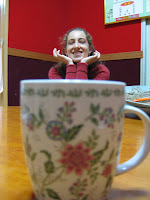
Anchovy Poop is a mix of young and old, married and unmarried Yangmok teachers. At school, they rarely addressed me, and when Okhee initially invited me to their outings they would smile at me warmly, and then I would sit back and observe as they gabbed, in Korean, about their husbands or their students’ officious parents. A breakthrough came one night at a dinner when Hyo Jin, the youngest member, drank a lot of wine. In the 3 months that I had known her, I had no idea that she could speak English. Suddenly, she was chatting away with me excitedly. Little by little, each of the members overcame their nervousness to speak with me and grappled with their limited English, my limited Korean, and our cell phone translation dictionaries to forge a friendship. One night at a restaurant, they had an odd request for me. They wanted to take a picture with a mug close to the camera and me far away such that it looked like I was sitting inside the mug. When I saw myself on the camera sprouting from a coffee cup making the typical Korean peace signs, I learned that this was my official initiation into the Anchovy Poop group.
There are 10 Korean teachers in Anchovy Poop, and exactly 9 of them changed schools in the spring, just as they began to warm up to me. Of the five oldest, the ‘mothers,’ Okhee and Sunny are the socialites and fashionistas of the gang. Yumi and Essuk are almost overbearingly friendly and might have the greatest laughs of any Koreans I know. Gyeongju, the music teacher, is a strong headed single woman who can sing like a diva and instigate a bus full of people to dance in the aisles. Of the younger clan, Ji Young and Yumi are adorable and can usually be found posing for pictures. They are under constant pressure from the others to get themselves hitched before it’s too late. Yoon Jung recently got married, bumping herself into the social status of an ‘ajuma.’ Mina is the shyest of the group, and recently learned to drive. She lived in my apartment building and was assigned the unfortunate task of driving me home after each outing. She would grip the steering wheel in terror, doubly nervous to be on the road and to be speaking English, although by the end of the year she was excited to have me as her travel companion. Finally, Hyo Jin, the youngest and the only one to remain at Yangmok, was the life of the party. This motley crew whisked me away to chaotic and hilarious adventures from Jeju Island to karaoke rooms to a charcoal sauna to Jeollanam-do, the south-western province, during which we spent more time all jammed into a single van on the road than sight-seeing. When Okhee broke the news to Anchovy Poop that I was returning to the U.S., they asked me, shocked, why I was leaving. I told them “Kachok” – family, and “Chingu” – friends. Ji Young looked at me wide-eyed and said “Uri-nun (We)…Kachok, Chingu…”
There are a lot of great things about Korea that make it worth visiting, like beautiful mountains, rocky beaches, and fantastic food. But there is no way I would have fallen in love with Korea the way I did if I had come only as a tourist. That is in large part thanks to my ‘jung.’ To me, their love was a lot bigger than anchovy poop. Maybe more like elephant poop.

Gyeongju
 Okhee
Okhee
 Essuk
Essuk
 Sunny
Sunny
 Gang Yumi
 Mina
Mina
 Yoon Jung
 Ji Young
 Seo Yumi
 Hyo Jin
 남달리
남달리
 Okhee
Okhee Essuk
Essuk Sunny
Sunny Gang Yumi
 Mina
Mina Yoon Jung
 Ji Young
 Seo Yumi
 Hyo Jin
 남달리
남달리
Subscribe to:
Posts (Atom)
